 ultimate-guide
Scaling Ecommerce Operations With AI: A 2026 Guide
Table of Contents
- Why Scaling Ecommerce Operations With AI Matters Now
- Real-Time Visibility Into Per-SKU Profitability
- AI-Driven Inventory Management Tools That Integrate With Your Stack
- Ecommerce Automation Best Practices for Growing Operations
- Measuring ROI of AI in Ecommerce: From Theory to Weekly Action
- Integration Without Rip-and-Replace: Protecting Your Data and Systems
- Handling Complexity: Multi-Channel, Multi-Warehouse Operations
- Getting Your Team Ready: Change Management for AI Implementation
- Frequently Asked Questions
Why Scaling Ecommerce Operations With AI Matters Now
Most ecommerce operations managers track inventory across spreadsheets, schedule labor via email, and wait weeks for profitability data. By the time you know which SKUs are profitable, the season has shifted and the data is stale.
Scaling ecommerce operations with AI changes this entirely. Instead of reactive firefighting, you get real-time visibility into what's working and what's draining margins.
At Scale Partners AI, we've spent 15 years helping logistics, ecommerce, and wellness businesses move past theoretical promises to actual weekly recommendations that teams can implement. This guide covers the operational shifts that matter most: real-time per-SKU profitability, demand forecasting, automated fulfillment coordination, labor optimization, and the change management required to make it stick.
Real-Time Visibility Into Per-SKU Profitability
You can't optimize what you can't see. Most ecommerce operations calculate profitability monthly or quarterly, which means you're always weeks behind reality (census.gov).
Real-time per-SKU profitability means knowing at any moment which products generate margin and which consume resources without return. AI systems ingest your cost data (landed cost, storage, handling, fulfillment), sales data (channel, price, discount), and operational data (returns, damage, labor) to calculate true profit per unit and flag bundling opportunities you'd never spot manually.
Data silos are the real enemy. If your inventory system doesn't talk to your accounting system, and neither connects to your fulfillment platform, you're calculating profitability with incomplete information. AI systems bridge those gaps, pulling data from multiple sources and surfacing patterns that spreadsheet analysis misses.
AI-Driven Inventory Management Tools That Integrate With Your Stack
The best AI-driven inventory management tools integrate with what you have. They don't replace your existing infrastructure; they sit on top of it, pulling data from your current system and feeding insights back into your workflow.
Integration architecture matters more than the tool itself. You need something that connects via API to your inventory platform, accounting system, and fulfillment network. If it requires manual data export or custom development for each connection, you've added complexity instead of reducing it.
The tools that work best are built around three core capabilities: demand forecasting, automated fulfillment coordination across warehouses and channels, and inventory optimization that balances stock levels against carrying costs.
Demand forecasting without manual spreadsheets
Demand forecasting without AI is guesswork. You look at last year's sales, add a growth percentage, and hope seasonality doesn't surprise you.
AI-driven demand forecasting ingests historical sales, seasonal patterns, promotional calendars, market trends, and external signals to predict what you'll actually sell. The system continuously adjusts reorder points and safety stock levels, feeding forecasts directly into your inventory planning instead of sitting in a spreadsheet you check occasionally.
Automated fulfillment and multi-channel coordination
Multi-channel ecommerce creates operational complexity fast. Orders arrive in different systems, inventory levels need synchronization, and fulfillment rules differ by channel.
Automated fulfillment coordination means orders from any channel flow into a single system. AI logic routes each order to the warehouse closest to the customer with available inventory or lowest fulfillment cost, depending on your rules. The system handles exceptions automatically: if inventory isn't available at the primary warehouse, it triggers a transfer or alerts you to a potential stockout.
Multi-channel coordination also means inventory synchronization happens in real time. Sell a unit on Amazon, and your Shopify inventory updates immediately, eliminating overselling.
Ecommerce Automation Best Practices for Growing Operations
Automation without strategy is expensive chaos. The practices that work focus on automating workflows that consume the most labor, create the most errors, or directly impact customer experience.
Labor scheduling and dispatch optimization
Labor is your largest controllable cost in fulfillment operations. Most teams schedule based on historical averages and gut feel, staffing for peak days and paying for idle time on slow days.
AI-driven labor scheduling predicts demand hour-by-hour and recommends staffing levels accordingly. It factors in employee availability, shift preferences, labor cost by role, and fulfillment time for different order types. Dispatch optimization routes drivers to customers in real time, assigning orders based on location, vehicle capacity, and delivery window.
Fraud detection and customer support automation
Fraud costs ecommerce operations 1-3% of revenue on average (peer-reviewed research). Manual fraud detection is reactive, catching problems after damage is done.
AI-driven fraud detection works in real time, analyzing order patterns, payment methods, shipping addresses, customer history, and external signals to flag high-risk orders before they ship. Customer support automation handles high-volume, repetitive questions, with chatbots handling 60-70% of common inquiries without human intervention.
Measuring ROI of AI in Ecommerce: From Theory to Weekly Action
Most AI implementations fail not because the technology doesn't work, but because teams can't measure whether it's working and can't act on the results.
ROI measurement requires clear metrics that connect to business outcomes and a cadence for acting on the data. Weekly is the right frequency for most operations.
Tracking operational metrics that matter
The metrics that matter are the ones that directly impact margin: fulfillment cost per order, labor cost per unit fulfilled, inventory carrying cost, stockout rate, demand forecast accuracy, and fraud rate.
Track them weekly. Compare actual performance to baseline and targets.
Avoiding the consultant trap: actionable recommendations vs. slide decks
The difference between a consultant trap and real operational improvement is specificity and timing. A real recommendation tells you exactly what to do this week, why it matters, and what you should measure to know if it worked.
Scale Partners AI's approach is built around weekly "fix this" recommendations. Instead of a 50-slide strategy document, you get a weekly email: "Your demand forecast for SKU-4782 is trending 18% below prediction. This is driven by a competitor promotion that ends Friday. Recommend reducing purchase orders by 200 units for next week's delivery. This saves $2,400 in carrying cost."
That's actionable. Your team can implement it immediately and measure the impact.
Integration Without Rip-and-Replace: Protecting Your Data and Systems
The second-biggest objection is: "Our data is messy. Do we need to clean everything up before we start?"
The answer is no. Messy data means less accurate predictions initially. As the system runs and learns from actual outcomes, accuracy improves. You don't need perfect data to start, you need good-enough data and a commitment to improving it over time.
Integration architecture separates a successful AI implementation from a costly mistake. You need systems that connect via APIs, not custom integrations that break when either system updates. A better approach than rip-and-replace is parallel operation: run your old system and the new AI system side-by-side for a period, then transition fully once you're confident in the new system's accuracy.
Data protection matters too. Your inventory, customer, and financial data are sensitive. Any AI system needs to handle that data securely: encryption in transit and at rest, access controls, and audit logging.
Handling Complexity: Multi-Channel, Multi-Warehouse Operations
Complexity scales exponentially, not linearly (peer-reviewed research). Two warehouses isn't twice as complex as one. The interactions between channels, warehouses, suppliers, and customers create combinatorial complexity that humans can't manage manually.
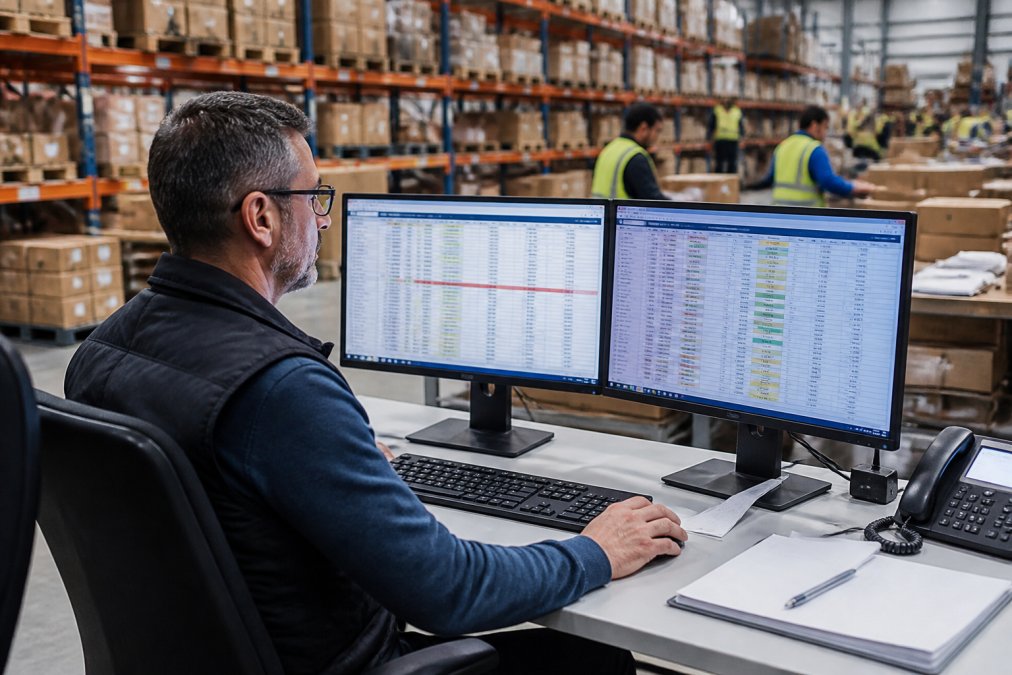
Real-time data processing becomes essential at this scale. You need to know inventory position across all warehouses simultaneously and route orders to the most efficient fulfillment location instantly.
With one warehouse, you optimize for fulfillment cost. With three warehouses across different regions, you optimize for a combination of fulfillment cost, delivery speed, and inventory position. An order might go to a more expensive warehouse if it gets to the customer faster, or to a less efficient warehouse if it reduces inventory imbalance.
Omnichannel integration is where most operations struggle. You're selling on your website, Amazon, Shopify, and potentially wholesale channels. Each channel has different rules. AI systems handle this by encoding your business rules and applying them consistently across all channels.
Getting Your Team Ready: Change Management for AI Implementation
The technology is the easy part. Getting your team to trust it, use it, and act on its recommendations is the hard part.
Most AI implementations fail because teams don't believe the system or don't understand how to use it. Change management requires three things: transparency about how the system works, early wins that build confidence, and feedback loops that let the team shape how the system operates.
Start with transparency. Explain to your team how the system makes decisions. A demand forecast isn't magic; it's looking at historical patterns, seasonal trends, and external signals. If your team understands the logic, they're more likely to trust the output.
Build in early wins. Start with something lower-stakes where the system can prove itself. Once the team sees that it works, they're more open to expanding it. Create feedback loops so the team's input shapes how the system operates.
Scaling ecommerce operations with AI isn't about replacing your team with automation. It's about giving your team better information and removing the manual work that prevents them from making good decisions.
The operations that scale successfully integrate AI into their existing systems, measure what matters, and act on the data weekly. At Scale Partners AI, we've built our approach around exactly that: no rip-and-replace, weekly recommendations your team can implement immediately, and real-time visibility into the metrics that drive margin.
If you're running multi-channel ecommerce or a 3PL operation and managing inventory and labor with spreadsheets and email, you're leaving margin on the table. Book a Discovery Call with our team to see how real-time per-SKU profitability and automated coordination can improve your operational efficiency without disrupting the systems you've already built.
Frequently Asked Questions
How can AI be used to automate ecommerce inventory management?
AI analyzes historical sales patterns, seasonal trends, and real-time demand signals to forecast inventory needs across multiple channels and warehouses. Machine learning algorithms flag overstock and understock conditions automatically, triggering reorder recommendations and preventing stockouts. This eliminates manual spreadsheet updates and reduces the operational complexity of managing SKUs across fulfillment centers.
What are the primary benefits of integrating AI into ecommerce operations?
AI-powered systems provide real-time visibility into per-SKU profitability, automate labor scheduling and dispatch coordination, and reduce fraud through behavioral anomaly detection. Operational efficiency improves through automated workflows that eliminate manual workarounds. Most critically, AI integrates with your existing software stack without requiring a costly rip-and-replace, protecting historical data and current integrations while delivering weekly actionable recommendations.
How does AI improve per-SKU profitability in ecommerce?
AI identifies bundling opportunities by analyzing which products sell together, flags low-margin SKUs that should be repositioned or discontinued, and optimizes dynamic pricing based on demand, competition, and inventory levels. Real-time data processing reveals which products drive customer acquisition versus which drive repeat purchases, enabling smarter merchandising decisions. Inventory turnover improves through accurate demand forecasting, reducing carrying costs and obsolescence. These insights compound: better inventory decisions free up cash flow, labor optimization reduces fulfillment costs per order.
What's the actual cost of implementing AI for ecommerce scaling, and can we start small?
Pricing depends on your operation's complexity, data volume, and integration scope. Scale Partners AI builds custom systems around your existing infrastructure, so you don't pay for unnecessary rip-and-replace costs. Most businesses start with focused optimization in one area, inventory forecasting or labor scheduling, and expand as ROI becomes clear. Contact Scale Partners AI for a discovery call to discuss your specific operation and get a transparent quote tailored to your scale and budget.
Can AI handle messy or incomplete data in our existing systems?
Yes, but data quality directly affects recommendation accuracy. AI systems can work with incomplete historical data, but the algorithms improve as data becomes cleaner and more consistent. Scale Partners AI typically begins by auditing your current data structure, identifying gaps, and building connectors that standardize incoming data without requiring you to pause operations or manually clean everything first. The system learns from available data while flagging data quality issues that, if resolved, would improve recommendations further.
How do you ensure AI recommendations actually work in our real operations?
Scale Partners AI delivers weekly actionable recommendations grounded in your actual operational constraints, not theoretical optimization. The system learns from what your team can realistically implement, factoring in staffing limits, warehouse layouts, and supplier lead times. Recommendations are tested against historical performance before being sent to you. For fitness studios and multi-warehouse ecommerce operations, this means labor scheduling suggestions that respect shift availability and member preferences, not impossible ideals.
What makes AI-driven optimization different from the consultant approach we've tried before?
Many consultants deliver slide decks and disappear; AI systems deliver weekly recommendations you can act on immediately. Scale Partners AI combines 15 years of operator experience with production-ready systems that integrate into your existing workflow. Instead of theoretical frameworks, you get specific actions: 'Bundle SKU-4521 with SKU-8834 to increase basket size by 8%' or 'Shift two team members from warehouse B to warehouse C on Thursdays.' The system continuously learns from your results, refining recommendations over time rather than handing off a static report.
How does AI handle the 80/20 rule in ecommerce operations?
The 80/20 principle states that roughly 80% of your revenue comes from 20% of your SKUs. AI identifies which products fall into that high-value 20%, then optimizes around them: prioritizing inventory for top performers, allocating labor to fulfill those orders faster, and using dynamic pricing to maximize margin on them. Simultaneously, AI flags the remaining 80% of SKUs to determine which should be bundled with top performers, discontinued, or repositioned. This focus prevents resources from being spread thin across low-impact products.