 how-to
Scale Operations Without Increasing Headcount: 2026 Guide
Table of Contents
- Why Headcount Growth Stalls Profits
- The Real Cost of Every New Hire
- Audit Workflows to Find Bottlenecks and Repetitive Tasks
- How to Improve Operational Margin in 2026 with AI
- Automation Strategies for Logistics and Ecommerce
- Optimizing Per-SKU Profitability Without Adding Staff
- Change Management: Getting Your Team On Board
- Frequently Asked Questions
Last Updated: September 23, 2026
Why Headcount Growth Stalls Profits
Every new hire feels like progress. Then payroll eats the margin you were trying to protect.
Scale operations without increasing headcount is the practice of growing revenue and output while holding your team size steady. It works by removing manual work, fixing process gaps, and using AI to handle the repetitive parts of the job. At Scale Partners AI, we've spent 15 years inside logistics, ecommerce, and wellness operations, and the pattern is consistent: companies hit a growth ceiling, hire their way past it, and watch operating margins shrink.
The math is simple. Revenue goes up. So does total compensation, benefits, and management overhead. Output per employee barely moves.
That's the trap. Below, we'll break down how to escape it, step by step.
The Real Cost of Every New Hire
A new hire costs far more than their salary. Total compensation includes payroll taxes, benefits, equipment, software seats, and onboarding time. Then there's the hidden layer: management attention, training hours, and the productivity dip while someone learns the role.
Many operators find that a single addition to a warehouse or support team adds meaningful recurring overhead before that person produces anything close to full output. Multiply that across a growing team and the drag compounds.
The bigger issue is what hiring doesn't fix.
Audit Workflows to Find Bottlenecks and Repetitive Tasks
Start by mapping how work actually moves through your operation, not how you think it moves. Most bottlenecks hide in the gaps between systems.
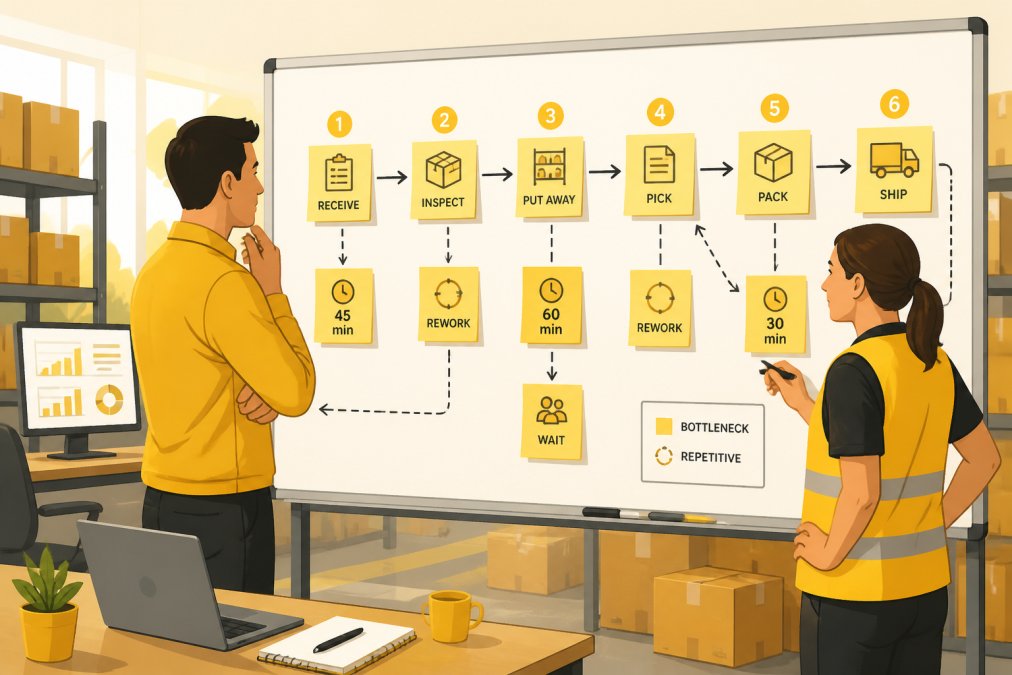
Map Core Processes and Spot Manual Workarounds
Walk through each core process: order intake, inventory updates, dispatch, invoicing, and contract renewals. At every step, ask one question: is a person copying data from one place to another?
Look for these signals:
- Someone exports a report and re-enters it elsewhere
- A spreadsheet lives outside your CRM
- Staff check multiple dashboards to answer one question
- Approvals happen over email or chat
- The same data gets typed twice
How to Improve Operational Margin in 2026 with AI
Improving operational margin in 2026 means raising output per employee, not cutting staff. AI does this by taking over repetitive tasks and surfacing decisions your team currently makes blind. The shift is practical, not theoretical. According to McKinsey's research on AI in operations, companies that apply AI to specific operational workflows see measurable gains in efficiency, while broad, undefined AI programs stall.
Run the Break-Even Math Before You Buy Anything
Most operators approve software on gut feel and then wonder why margin didn't move. The fix is a simple break-even calculation you can run in a spreadsheet in under an hour.
- Quantify the hours. For the workflow you're considering, estimate hours per week spent on it across everyone who touches it. Multiply by a fully loaded hourly rate (salary plus payroll taxes, benefits, and overhead, not base wage).
- Estimate the recoverable share. No tool removes 100% of the work. A realistic automation target is often 40-70% of the manual hours, with the remainder going to exceptions and oversight.
- Annualize the savings. Recoverable hours × loaded rate × 52 weeks gives you the gross annual value.
- Compare to total cost of ownership. Add subscription fees, implementation, integration work, and the internal hours to configure and maintain the tool. Don't forget the first 60-90 days, when productivity often dips before it improves.
- Calculate payback period. Total cost of ownership ÷ monthly savings. If payback stretches past roughly 12-18 months, the workflow is probably not the right first target.
Where to Point AI First
| Problem | AI Fix | Impact |
|---|---|---|
| Manual inventory counts | Automated stock sync | Fewer stockouts and overstock |
| Guesswork scheduling | Demand-based labor forecasts | Lower overtime costs |
| Blind pricing | Per-SKU margin tracking | Better bundling decisions |
| Reactive retention | Churn signal alerts | Fewer lost members |
Rank candidates by three filters: hours consumed, error rate, and how reversible the decision is. High-hours, high-error, low-stakes workflows are the safest first wins. High-stakes decisions (pricing changes, credit approvals) deserve a human in the loop until the model has a track record.
The Risk Nobody Models: Over-Automation
Every hour you remove from a process also removes the human judgment that used to catch edge cases. Highly automated operations are efficient right up until an input changes, a new supplier format, a carrier outage, a pricing rule that no longer applies, and then they fail silently and at scale.
Guardrails that keep automation resilient:
- Keep a documented manual fallback for every automated workflow
- Alert on exception volume, not just error volume, a spike in exceptions is an early warning
- Review automated decisions monthly against a sample of human-judged cases
- Assign a named owner for each automated workflow, not a committee
Automation Strategies for Logistics and Ecommerce
Automation strategies for logistics and ecommerce work best when they target coordination, not just tasks. The hard part isn't moving a box. It's knowing which box, for which order, with which carrier, at the right time.
Focus automation on the handoffs:
- Sync inventory across every sales channel in real time
- Auto-generate dispatch routes from order data
- Trigger reorders when stock crosses a threshold
- Flag orders at risk of late delivery
- Reconcile invoices against shipments automatically
Optimizing Per-SKU Profitability Without Adding Staff
Optimizing per-SKU profitability starts with seeing true cost per item, not just revenue per item. Most catalogs carry a mix of winners, break-even items, and quiet losers.
Once you can see margin by SKU, patterns appear:
- Bundles that lift average order value
- Slow movers tying up cash in the warehouse
- Products that look profitable until shipping and returns are counted
Change Management: Getting Your Team On Board
New systems fail when people resist them, not when the technology breaks. Change management is the work of making the new way easier than the old way, and in a "scale without headcount" initiative, it starts with an uncomfortable truth: your team will assume automation is a layoff plan unless you tell them otherwise, clearly and repeatedly.
Name the Commitment Out Loud
If the goal is to grow revenue while holding headcount steady, say so in plain language at the kickoff. Then back it with a mechanism, not a slogan:
- Redeployment, not reduction. When a task is automated, publish where those hours are going, new accounts, new channels, higher-value work. If you can't answer that, the initiative isn't ready.
- No silent headcount cuts tied to the program. If layoffs happen for unrelated reasons during the rollout, address the timing directly. Ambiguity here poisons every future initiative.
- Visible wins go to the team. When a workflow saves 20 hours a week, the person who used to do it should be the one presenting the result.
Run the Rollout Like an Operations Project
A common mistake is announcing a tool and expecting adoption. Instead, involve the people doing the work in the audit, they know where the workarounds live, and they'll spot failure modes your implementation plan missed.
Practical steps:
- Show the team what the change removes, not what it adds
- Pick one visible win in the first month and instrument it so the gain is measurable
- Assign an owner for each new process, with authority to change it
- Measure and share the result publicly, including what didn't work
- Build a feedback loop with a fixed cadence (weekly during rollout, monthly after)
Watch for Burnout, Not Just Resistance
"Do more with less" has a failure mode that looks like success: the team absorbs the new tooling on top of their existing load, hits the targets for a quarter, and then quietly disengages. The warning signs are familiar, rising sick days, slower response times on non-automated work, and the same two people carrying every new process.
Countermeasures that actually work:
- Cap the number of simultaneous process changes per team (one or two, not five)
- Track hours saved and hours added separately, net savings is the only number that matters
- Rotate ownership of new workflows so the load isn't concentrated
- Treat adoption metrics as a leading indicator of burnout, not just a compliance checkbox
Frequently Asked Questions
How can a business scale without increasing headcount?
Scale operations by automating repetitive tasks, standardizing processes, and using AI to surface bottlenecks. Start with a workflow audit to identify high-volume manual work, then apply automation to dispatch, invoicing, and inventory tracking. This frees existing staff for higher-value work and improves output per employee without new hires.
What are the risks of scaling operations without adding staff?
The main risks are over-automation that removes human judgment, employee burnout from poorly redistributed work, and data quality issues if inputs are messy. Mitigate by piloting changes, keeping people in the loop for exceptions, and monitoring operating margins monthly. Change management is as important as the technology itself.
Which operational processes should be automated first to save labor?
Prioritize repetitive, rule-based tasks with clear inputs and outputs: order dispatching, invoice generation, contract renewals, and inventory reorder alerts. In logistics and ecommerce, automating these can cut hours of manual coordination per week. Start with one process, measure the time saved, then expand to the next bottleneck.
How does AI impact operational margin in 2026?
AI improves operational margin by reducing labor costs per unit, flagging unprofitable SKUs, and optimizing resource allocation. For logistics and ecommerce, AI-driven demand forecasting and dynamic labor scheduling can lift margins by cutting overtime and dead stock. The key is integrating AI into existing systems rather than replacing them, so you see ROI without disruption.
Scaling without adding staff is a process problem before it's a technology problem. Most teams can't see where the hours go or which products actually make money, so they hire to cover the gap. Scale Partners AI fixes that with custom, production-ready AI systems that plug into your current software, flag margin opportunities, and give you real-time visibility into per-SKU profit. Book a discovery call with Scale Partners AI and start scaling your operations with precision.