 blog
blog
RTS Labs vs AltaDX: Which AI System Fits Your Operations
Table of Contents
- RTS Labs vs AltaDX: Core Positioning
- AI Operations Audit: How Each Platform Approaches Assessment
- Custom AI System Integration Capabilities
- Industry Focus: Where Each Platform Excels
- Implementation, Timeline, and ROI Benchmarks
- AI Consulting Services for Enterprises: Delivery Model Differences
- Which Platform Should You Choose?
- Frequently Asked Questions
Last Updated: September 22, 2026
RTS Labs vs AltaDX: Core Positioning
The choice between RTS Labs vs AltaDX comes down to how each platform turns operational data into actionable intelligence. Both position themselves as enterprise AI consultants, but their philosophies diverge significantly in delivery approach.
RTS Labs emphasizes rapid deployment and integration with existing infrastructure, building AI agents that work within your current software stack without requiring a complete system overhaul.
AltaDX emphasizes custom-built AI systems tailored to industry-specific workflows, prioritizing comprehensive data architecture assessment before implementation.
The distinction is speed versus depth: one gets you running faster; the other invests more time upfront to ensure a solid foundation. For operations managers at 3PL providers, e-commerce founders, and wellness studio owners, this difference shapes timeline and ongoing support. The question isn't which is objectively "better", but which aligns with your readiness level, complexity, and timeline.
AI Operations Audit: How Each Platform Approaches Assessment
An AI operations audit evaluates your current systems, data quality, and operational pain points to recommend where AI creates the most impact. The audit process, what gets measured, how findings are prioritized, and what gets delivered, is where the two approaches diverge most sharply.
RTS Labs conducts a rapid assessment (2-4 weeks) focused on identifying quick wins: software stack inventory, workflow mapping, data accessibility testing, and ROI screening. Output is a prioritized list ranked by implementation difficulty and expected ROI, for example, "Inventory discrepancy alerts (2-week build, 8% accuracy improvement), labor scheduling optimization (3-week build, 12% efficiency gain)." RTS Labs avoids recommending architectural changes, identifying what can be built on your existing foundation rather than what should be rebuilt.
AltaDX conducts a comprehensive data governance foundation audit (6-8 weeks) including data architecture assessment, data quality scoring, compliance mapping, technical debt inventory, and scalability testing. Output is a detailed roadmap addressing technical debt before building new AI systems, often recommending infrastructure changes like cloud migration or data warehouse implementation.
A rapid assessment gets you moving quickly but might miss structural issues, for example, discovering six months in that your CRM doesn't expose needed data through its API. A comprehensive audit takes more time but reduces the risk of building on unstable foundations. RTS Labs trades upfront discovery time for faster time-to-value; AltaDX trades upfront time for lower technical risk. For stretched operations teams, a faster audit provides relief. For organizations with complex compliance, messy data, or legacy systems, the deeper approach prevents costly rework downstream.
Custom AI System Integration Capabilities
RTS Labs specializes in integration-first development, building AI agents that sit on top of your current infrastructure and communicate through APIs. This means no rip-and-replace, no data migration, and historical data stays intact. The tradeoff: your AI systems are constrained by what your existing software exposes through its API layer.
AltaDX builds custom systems from the ground up, creating new data pipelines and processing layers. This gives more flexibility but requires deeper integration work and may recommend architectural changes. If your systems are modern and well-maintained, RTS Labs' approach gets you to production faster and costs less. If your systems are legacy or fragmented, AltaDX's custom approach may be necessary but demands more investment and longer timelines.
Industry Focus: Where Each Platform Excels
RTS Labs has built significant expertise in e-commerce and logistics, excelling at inventory optimization, demand forecasting, and labor coordination in warehouse environments. Their systems handle seasonal demand swings, real-time inventory visibility, and dynamic routing.
AltaDX emphasizes regulated industries where data governance, audit trails, and compliance documentation are non-negotiable. They excel when your industry requires proof that AI recommendations comply with specific regulations.
For wellness and fitness studios, RTS Labs' labor coordination and member retention focus aligns well with studio operations. The industry focus question is straightforward: if your operation matches their specialization, you get a platform that understands your specific challenges.
Implementation, Timeline, and ROI Benchmarks
Implementation timeline and ROI realization determine whether your AI investment pays off in months or years. Timeline and ROI depend heavily on your current infrastructure maturity, data quality, and workflow complexity.
RTS Labs Implementation Phases and Timeline
RTS Labs typically delivers initial AI systems in 8-12 weeks. Early wins appear within 4-6 weeks (automated alerts, labor scheduling optimization). For e-commerce operations, typical first-quarter ROI metrics include 3-8% reduction in inventory carrying costs, 5-12% improvement in labor scheduling efficiency, and 2-5% reduction in order fulfillment time. However, older systems or poor data quality can extend the timeline to 14-16 weeks.
AltaDX Implementation Phases and Timeline
AltaDX's timeline is longer, typically 16-24 weeks from assessment to production deployment. The additional time reflects their comprehensive approach to data architecture and compliance validation. The typical phasing includes:
- Weeks 1-8: Foundation phase. Comprehensive audit completed (as described above); data architecture designed; compliance requirements documented; technical debt prioritized.
- Weeks 9-14: Infrastructure and data preparation. New data pipelines built if needed; data warehouse or data lake implemented; historical data migrated and validated; compliance controls implemented (audit logging, access controls, data encryption).
- Weeks 15-18: AI system development and testing. Custom AI models built to specifications; tested against compliance requirements; validated in staging environment.
- Weeks 19-24: Staged production rollout. System deployed to production with continuous monitoring; team training and change management; optimization based on live performance.
When AltaDX systems go live, they're typically handling more complex workflows with fewer constraints because foundational issues have been addressed. However, their systems often deliver more substantial improvements, often 15-25% operational gains in the first year, because they've optimized the entire workflow, not just the AI layer.
ROI Benchmarks by Use Case and Infrastructure Maturity
ROI varies significantly by industry, current system maturity, and the workflows being automated:
E-commerce and logistics (RTS Labs typical): 8-12 week deployment, 3-8% inventory cost reduction, 5-12% labor efficiency improvement, 2-5% order fulfillment speed improvement. Payback period typically 4-6 months.
E-commerce and logistics (AltaDX typical): 16-24 week deployment, 12-18% inventory cost reduction, 15-22% labor efficiency improvement, 8-12% order fulfillment speed improvement. Payback period typically 6-9 months, but sustained improvements are larger.
Wellness and fitness studios (RTS Labs typical): 8-12 week deployment, 3-7% member retention improvement, 8-15% staff scheduling efficiency, 2-4% class capacity optimization. Payback period typically 5-7 months.
Regulated industries (AltaDX typical): 20-28 week deployment, 10-20% operational efficiency improvement, 15-30% compliance risk reduction, 5-15% cost savings from eliminated manual compliance work. Payback period typically 8-12 months due to longer deployment, but compliance risk reduction provides value independent of ROI.
Timeline Extension Factors
Several factors can extend both platforms' timelines:
- Legacy system integration complexity. If your primary systems (ERP, CRM, WMS) are 10+ years old or lack modern API capabilities, integration work extends by 4-8 weeks for either platform.
- Data quality issues. If historical data has >20% missing values, inconsistent formatting, or significant duplicate records, data cleanup work adds 3-6 weeks before model training can begin.
- Compliance requirements. Healthcare, financial services, or other regulated industries require additional validation, audit logging, and compliance documentation, typically adding 4-8 weeks to any timeline.
- Organizational change management. If your operations teams are resistant to AI recommendations or lack training on new systems, change management and training can extend rollout by 2-4 weeks.
- Multi-location or multi-system deployments. If you operate across multiple warehouses, stores, or business units with different systems, each location adds 2-4 weeks to the timeline.
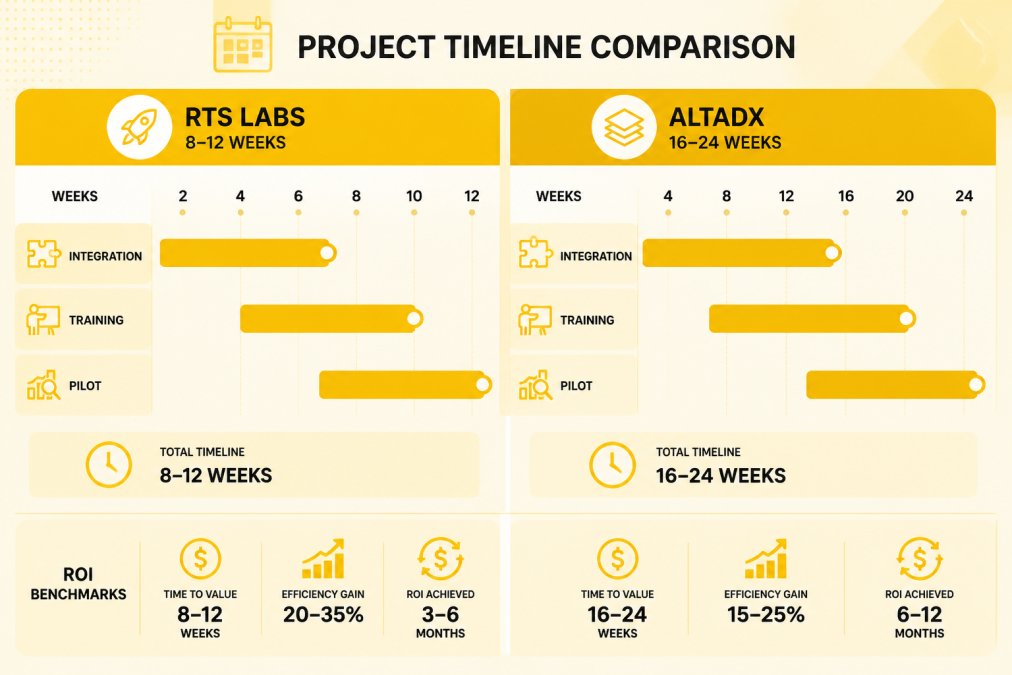
The Timeline-ROI Tradeoff
A common mistake is assuming faster implementation automatically means faster ROI. A quick deployment that doesn't address data quality issues might deliver modest improvements (3-5% operational gains) but require ongoing manual intervention to validate AI recommendations. A longer implementation that fixes foundational problems might deliver dramatic improvements (15-25% operational gains), but you're waiting longer to see them. The true ROI comparison requires calculating not just payback period, but total value over 24 months: a slower deployment with larger sustained improvements often delivers 2-3x more total value than a faster deployment with modest improvements.
AI Consulting Services for Enterprises: Delivery Model Differences
Beyond the initial implementation, how each platform supports your systems long-term shapes the true cost of ownership and ongoing value realization.
RTS Labs operates a "systems in production" model. Once your AI systems are deployed, their team focuses on optimization and refinement. They monitor system performance, retrain models as your data evolves, and adjust recommendation thresholds based on operational feedback.
Which Platform Should You Choose?
The decision between RTS Labs vs AltaDX for AI systems depends on where your organization stands across four dimensions: timeline urgency, infrastructure maturity, complexity tolerance, and strategic readiness.
Frequently Asked Questions
What is the core difference between RTS Labs and AltaDX for AI systems?
RTS Labs and AltaDX serve different operational priorities. RTS Labs emphasizes enterprise-scale data architecture and compliance-focused AI implementation across regulated industries. AltaDX specializes in fitness and wellness AI solutions, particularly member retention and scheduling optimization. Your choice depends on whether your business operates in regulated sectors requiring strict governance or focuses on wellness operations seeking real-time member insights. Understanding your industry's specific compliance needs and operational bottlenecks will clarify which platform aligns with your requirements.
Do I need an AI operations audit before choosing between RTS Labs and AltaDX?
An AI operations audit helps you identify data gaps, integration compatibility issues, and realistic ROI expectations before committing to either platform. Both RTS Labs and AltaDX can assess your current systems, but the audit process differs: RTS Labs typically conducts deeper infrastructure reviews for enterprise environments, while AltaDX focuses on member data workflows and scheduling inefficiencies. If your data quality is uncertain, your systems are fragmented across multiple tools, or you're unsure about implementation timelines, an audit from either vendor will clarify your actual readiness and expected costs.
Which platform offers better custom AI system integration with legacy software?
Both platforms claim no rip-and-replace integration, but their legacy compatibility varies. RTS Labs builds custom AI system integration around enterprise data architectures and can handle complex multi-system environments with significant technical debt. AltaDX integrates primarily with fitness management platforms and member databases. If you operate multiple warehouses, e-commerce channels, or fragmented inventory systems, RTS Labs' enterprise-grade integration approach may be more suitable. If your legacy systems are wellness-specific, AltaDX's specialized integration may deploy faster and with lower complexity.
How long does implementation typically take with each platform?
Implementation timelines depend on your data readiness and system complexity. RTS Labs typically requires 8-16 weeks for enterprise deployments due to data architecture setup and compliance validation. AltaDX generally deploys faster for wellness operations, typically 4-12 weeks, since their integrations focus on narrower use cases. Both platforms deliver weekly recommendations once live, but the initial deployment differs significantly. Request specific timelines from each vendor based on your current system stack and data maturity; faster deployment often correlates with simpler operations rather than platform capability.