 how-to
Improve Warehouse Labor Efficiency: A 2026 How-To
Table of Contents
- Assess Your Current Warehouse Labor Efficiency Baseline
- Warehouse Labor Productivity Metrics That Drive Real Change
- Implement AI Recommendations for Warehouse Efficiency in 2026
- Optimize Warehouse Layout and Picking Strategies
- Reduce Warehouse Labor Turnover Through Better Conditions
- Integrate Automation Without a Full System Overhaul
- Measure, Monitor, and Iterate Weekly
- Frequently Asked Questions
Last Updated: September 23, 2026
Warehouse labor efficiency isn't a luxury for growing e-commerce and logistics companies anymore, it's the difference between scaling profitably and burning cash. Most operations still rely on manual scheduling, paper-based picking lists, and guesswork about which staff members work best on which tasks. The result? Wasted hours, frustrated teams, and margins that shrink faster than inventory turns over.
This guide from Scale Partners AI covers practical, actionable steps to improve warehouse labor efficiency in 2026. We've worked with 3PLs, e-commerce founders, and logistics teams for 15 years, and we know what actually moves the needle. Below, we'll show you exactly how to assess your baseline, implement AI-driven recommendations, and build sustainable labor practices without ripping out your existing systems.
Assess Your Current Warehouse Labor Efficiency Baseline
You can't improve what you don't measure. Most warehouses track throughput and order accuracy, but they miss the labor productivity picture entirely. Start by identifying your key metrics right now, not next quarter, today.
Key Metrics to Track Right Now
Pick accuracy and cycle time are your foundation metrics. Picking accuracy measures the percentage of items selected correctly on the first attempt. Cycle time tracks how long it takes from order receipt to shipment. Both matter because a fast picker who makes mistakes costs more than a careful one who's slightly slower.
Labor use shows what percentage of your team's paid time actually moves inventory. Many warehouses discover that their use sits between 40-60%, meaning nearly half the payroll goes to waiting, walking, or low-value tasks.
Track these metrics weekly:
- Picking accuracy rate (target: 98%+)
- Average cycle time per order (measure in minutes)
- Labor use percentage (actual productive time ÷ total paid hours)
- Orders per labor hour (throughput metric)
- Employee turnover rate (monthly percentage of staff departing)
Document your baseline for each metric. Write it down.
Warehouse Labor Productivity Metrics That Drive Real Change
Picking accuracy and throughput are connected, but most teams treat them separately. When you optimize one without the other, you create bottlenecks. A team that picks 200 orders per hour but gets 15% wrong has actually completed 170 orders correctly. The math is brutal.
Picking Accuracy and Cycle Time
Picking accuracy directly affects your return rate, customer satisfaction, and labor costs downstream. Each error requires a correction pick, a quality check, and often a customer service interaction. Improving accuracy by 2-3 percentage points cuts rework by 20-30%.
Reduce cycle time by:
- Eliminating unnecessary walking and searching for items
- Batching similar orders together
- Organizing your layout so fast-moving items are closest to packing stations
Labor Use and Throughput
Labor use is the metric most operations get wrong. You're paying someone for eight hours. How many of those hours are they actually picking, packing, or moving inventory? The rest is walking to find items, waiting for instructions, or handling exceptions.
Implement AI Recommendations for Warehouse Efficiency in 2026
AI systems can now analyze your labor patterns, order mix, and warehouse layout to recommend specific, actionable changes. The key is that these recommendations must be implementable, not theoretical slide decks, but actual fixes your team can execute this week.
Real-Time Workload Balancing
Real-time workload balancing means assigning tasks to team members based on their current capacity and skill level. Instead of a supervisor manually dividing work, an AI system monitors who's available and assigns the next order to whoever can complete it fastest without overloading them.
Implement this by:
- Using your warehouse management system to track task assignments in real time
- Setting rules for which staff members are best suited to different task types
- Monitoring completion rates and adjusting assignments dynamically
Predictive Scheduling and Demand Forecasting
Demand forecasting predicts order volume for the next week or month. With accurate forecasts, you schedule the right number of people at the right times. Under-schedule and you miss service levels. Over-schedule and you waste payroll.
Build this step by step:
- Export 12 months of order and staffing data
- Identify seasonal patterns and growth trends
- Run a forecast for the next 4 weeks
- Compare predicted demand to actual results and refine
Optimize Warehouse Layout and Picking Strategies
Your warehouse layout determines how far your team walks every shift. A poorly organized layout can add 2-3 hours of walking per day per person. That's wasted labor. Optimizing layout pays back in weeks.
Slotting and SKU Velocity
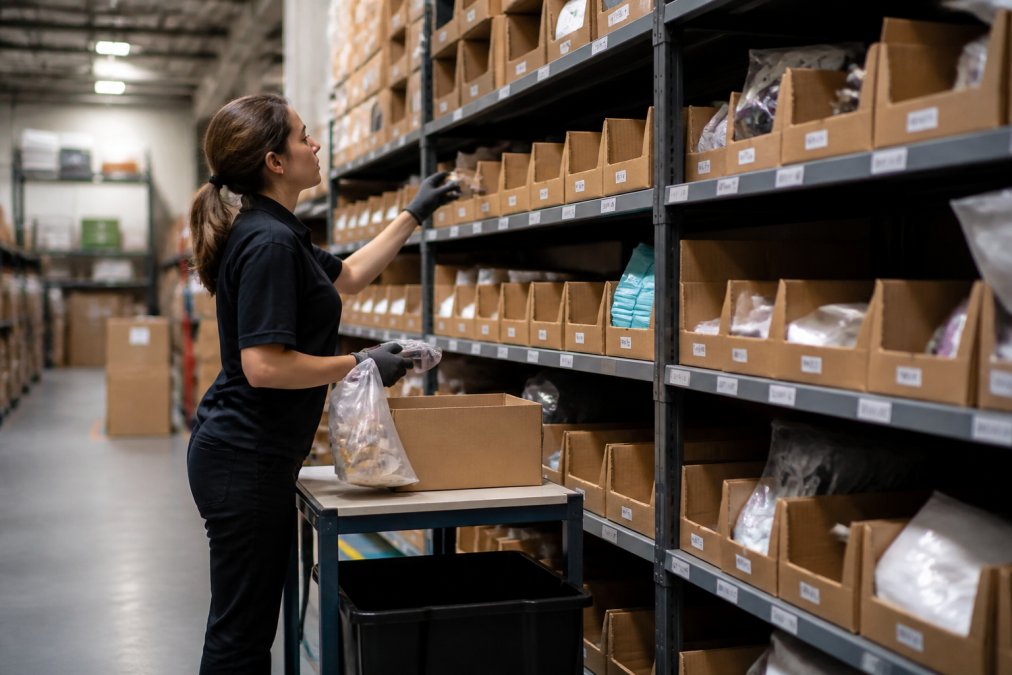
Slotting is the science of placing products in your warehouse based on how fast they sell. High-velocity SKUs, items that move quickly, belong in the most accessible locations. Slow-moving items go to harder-to-reach spots.
Implement slotting by:
- Analyzing sales data for the last 90 days
- Ranking SKUs by velocity (units sold per week)
- Moving top 100 SKUs to prime locations (waist-height, closest to packing)
- Moving slow movers to less convenient spots
- Remeasuring velocity monthly and adjusting as needed
Reducing Travel Time and Movement
Travel time is the distance your team walks to complete a pick. Minimize it and you dramatically improve throughput. A picker who walks 50 feet per order completes fewer orders than one who walks 15 feet per order, assuming equal picking accuracy.
Reduce travel time by:
- Organizing picks into batches (group similar items or nearby locations)
- Using pick-to-light systems or mobile devices that guide pickers to the next item
- Designing aisles so pickers move in logical patterns (not back-and-forth)
- Placing frequently picked items together, even if they're different products
Reduce Warehouse Labor Turnover Through Better Conditions
Turnover kills efficiency. Every time someone leaves, you lose institutional knowledge, spend weeks training a replacement, and watch productivity dip. The real cost of turnover is 50-150% of annual salary when you factor in recruiting, training, and lost output.
Ergonomics and Workplace Safety
Ergonomic workstations reduce injury and fatigue. A picker working at the wrong height or angle gets tired faster, makes more mistakes, and is more likely to leave. Good ergonomics isn't just humane, it's profitable.
Design picking stations so that:
- Items are at waist height (reduce bending)
- Monitors and pick lists are at eye level
- Packing tables are at elbow height
- Staff can reach items without stretching or twisting
Mental Health and Burnout Prevention
Warehouse work is physically demanding and often monotonous. Staff burnout leads to absenteeism, higher error rates, and ultimately turnover. Preventing burnout is a labor efficiency strategy, not just a wellness initiative.
Common burnout triggers in warehouses:
- Unrealistic daily targets that force rushing
- Lack of variety in tasks
- Poor communication from management
- Unclear growth paths or advancement opportunities
- Inadequate breaks or recovery time
Reduce burnout by:
- Setting achievable daily targets based on actual capacity
- Rotating tasks so people don't pick the same items all day
- Providing regular feedback and recognition
- Offering cross-training so people develop new skills
- Ensuring adequate break time and recovery periods
Integrate Automation Without a Full System Overhaul
You don't need to replace your entire warehouse management system to get efficiency gains. Incremental automation paired with better labor practices delivers results faster and costs less.
Automated Storage and Retrieval Systems (AS/RS)
AS/RS systems use robots or mechanical arms to store and retrieve items. They're expensive upfront but reduce labor and increase throughput significantly. However, you don't need full AS/RS to benefit from automation.
Start smaller:
- Implement pick-to-light systems (lights guide pickers to the right location)
- Add mobile devices so pickers scan items instead of using paper lists
- Use conveyor systems to move items between stations
- Deploy collaborative robots for high-volume, repetitive tasks
Human-Robot Collaboration and Change Management
Robots work best alongside humans, not instead of them. A collaborative robot might handle heavy lifting while a human picks items. This reduces fatigue and injury while maintaining the flexibility that humans provide.
Implement change by:
- Communicating the plan 4-6 weeks before deployment
- Offering training and upskilling programs
- Involving staff in process design (they know what works)
- Celebrating early wins and sharing results
- Adjusting plans based on feedback
Measure, Monitor, and Iterate Weekly
Improvement is a process, not a one-time project. Track your metrics weekly. Compare to baseline. Identify what's working and what isn't. Adjust.
Set up a simple dashboard:
- Pick accuracy (target: 98%+)
- Cycle time (target: 4-6 hours)
- Labor use (target: 70%+)
- Throughput per labor hour (track weekly trend)
- Turnover rate (track monthly)
Frequently Asked Questions
What are the key metrics for measuring warehouse labor efficiency?
The core metrics are picking accuracy (percentage of error-free picks), dock-to-stock cycle time (hours from receiving to inventory availability), labor productivity (units processed per hour per worker), and order fulfillment rate. Track these weekly to identify bottlenecks. Inventory turnover and SKU velocity also reveal which products are moving efficiently and which are tying up labor. Without these baseline numbers, you can't identify where improvements will have the highest impact.
How can AI recommendations for warehouse efficiency actually improve labor productivity in 2026?
AI analyzes real-time workload data to balance tasks across your team, flag bottlenecks before they slow throughput, and suggest optimal picking routes based on current inventory layout. Predictive scheduling uses historical demand patterns to staff appropriately, reducing both overtime costs and idle time. The key difference from generic software is weekly, actionable recommendations that integrate with your existing systems, not theoretical slide decks. AI-driven insights on per-SKU profitability also help you focus labor on high-margin items.
What's the fastest way to reduce warehouse labor turnover?
Address ergonomic pain points and workload visibility first. Workers leave when they're physically exhausted or feel their effort is invisible. Implement proper ergonomic workstations to reduce injury, rotate high-repetition tasks to prevent burnout, and share real-time performance dashboards so staff see the impact of their work. Mental health support programs and transparent career pathways also matter. These changes cost far less than recruiting and training replacements.
Do we need to replace our entire warehouse management system to improve labor efficiency?
No. The most effective approach integrates AI recommendations and labor management tools with your existing WMS and inventory systems. This avoids costly migrations, preserves historical data, and lets you start small. Begin by tracking the metrics outlined above, then layer in AI-driven scheduling and workload balancing. You can add automation (conveyor systems, vertical lift modules, AS/RS) gradually as ROI becomes clear, rather than betting everything on a full overhaul.